BACK COVER:Shriner Logo. Photograph by Mari Kono, Layout and Image design by Margaret Murray.
The Sphinx is a creature that evades the cycle of the nychthemeron through a correction of the animality in man. The animal self (nafs al-haywaniyya) is the lowest incarnation of man in the hierarchy of creation. Stripped of his reverence for God, man is nothing but an animal obedient to the base natural impulses. The raison d’etre for man is to become the locus of God’s manifestation. When man falls below this hierarchical level he is a mere animal.
The Sphinx is the proto-type synthesis of Holy Animality. It is for fallen man to re-establish the divine instinctivety of the 'Principle of Spontaneous Obedience to God' represented by the Arcanum of the Sphinx.
There is an automatic reflex inherent to the psychic nature of the animalized man. This is caused by the mobility of the wheel of animality through which the base desires afflict man for the duration of the nychthemeron; whether in his waking or sleeping states. The Sphinx who is beyond such temporal rotations lies at the hub of this wheel and it is the animalised man which proceeds away from the center.
There are many variations on the sphinx, two of which will concern us here. The first is known as the Androsphinx, for it is the unison of the human & animal. It is usually depicted with the upper-torso and head of man and the lower body of a lion. In Egypt this Sphinx was the emblem of Divine sovereignty as its human half was always represented the vicar of God on earth. The incarnation of the Solar deity Ra was the God-Man (theandros) Pharoah who govern the spiritual and material worlds with a two-fold sovereignty. The Great Sphinx of Giza is the most famous image of this royal beast. It faces directly towards the eastern horizon, where the sun rises at the spring and autumn equinoxes and became known as the Harmakhis which means 'Lord of Two Horizons', a concept directly linked to the cycle of the nychthemeron and the image of man’s life.
The second variant on the Sphinx is an amalgamation of four different animal forms: the hind quarters of a bull, the forepart of a lion, the wings of an eagle and the upper torso and head of a man thus evoking the bestiary of the Tetramorph, the form of 'Holy Animality' (Chayot). This creature is the vitality that provides the animative qualities of life, whether biological life in the state of fallen animality (βίος) or the Life of 'Holy Animality' (ζωή).
As the animal is the synthesis of the mineral and vegetable kingdoms, man is the resolution and goal of the animal kingdom and the Sphinx is the final enigma where Holy Animality is achieved through man. This Divine beast is the protector of the mystery of Life.
The two Androsphinx upon the cover of First Grand Constitution & Bylaws depict the following ratio: What the animal is to the human, the human is to the Divine. The animal aspect of the Sphinx represents the incarnational aspect of the human: 'Man who lives on Earth'. The Sphinx’s human part speaks of man’s Divinity: 'Man made in the image of God'. It is for this reason that the Sphinx is called the animal with two hearts. The heart of the beast inclined towards the passions and the human heart striving towards the Intelligence of the noble faculties. What must be remembered here is that genuine animality is a natura naturans and is considered as the archetypal form which provides organisms with their élan vitaland makes them living creatures (ζωή); whereas the wild beast (θηρίον) is a natura naturatawhich is inclined towards degeneration. Thus, the cryptozoology of the Sphinx suggests that it is not merely a beast but rather a Holy Animal.
The Lion’s mane is a well known symbolic icon of the sun’s corona depicted in much heraldry as a sovereign halo indicating heroism and victory of the 'unconquered sun' (sol invictus). When the sun passes through the constellation of Leo, the northern hemisphere experiences the longest and hottest days of the year, thus the Sun's domicile is within Leo, whose astrological properties signify strength and courage. It is courage only as courage is derived from conscious knowledge of the law typified by the symbolism. Strength or Force, alludes to the fiery Life-Power (ζωή) which moves the fluidic circulatory system of physical life (βίος) indicating a double-force whose symbol is a dual-lion.
The first aspect of the lion is that it is the king of all beasts (pan-therion) ruling over all subhuman forces innate in bio-electrical vitals, the second aspect is that it symbolizes the instinct that can be designated as 'courageous moral conscience'. The first lion is the king of beasts, whose ferociousness strikes fear into the hearts of its prey. When the bestial lion is restrained, moral courage is elevated. Ferociousness is to moral courage as the bestial lion is to the 'Lion of Divine Instinctivity', and these are the two tendencies that make the double-force distinct. A contra-versing current that combats and annihilates and a con-versing trait ever-seeking to participate and unite through co-operation.
Both these forces are contained in the one body with two different orientations, but the double-force only arises when the lion of bestial nature is tamed. In Egyptian lore this co-operation itself is also worked through the Ruti (double-lion) in the saying from the texts: "I am the twin Lions"
Force is the breath of wind that "moved upon the face of the waters'' in the Genesis of creation. This power is divinized in the Egyptian aspect of the Lion Shu and his sister lioness Tefnut who are born from the breath of Atum. Shu's name means 'drynesss'– rising upwards' and thus personifying air, the element audible in the howling wind, but apprehended as the roaring Lion. Shu was also equated with the ascending trait of the Sun. Tefnut’s name means 'moisture-dripped' (tef) from 'sky' (nut) with the downward tendency of the sunset. As a pair Shu is the male Lion of Divine Instinct and Tefnut is the lioness of ferociousness.
It is no surprise to us that the term Σφίγξ (sphinx) is derived from the verb σφίγγω meaning 'to strangle', for it was the lionesses would kill their prey by a strangulation bite to the throat and it is also the throat which offers passage to the voice and breath. The whole concept of the Sphinx relates to passageway, of the Sun entering the underworld (Duat).
Positioned back to back, the Ruti face the horizons of East & West and represent the movement of the Sun from yesterday (safre) into tomorrow (tua). Together they balance the autumnal and vernal equinox through the two solstitial doors to the underworld (Duat)...
"…and God separated the light from the darkness. God called the light Day and the darkness he called Night". GEN I: 4-5
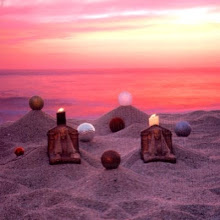
The imagery of this cover situates our initial orientation in the cosmology underlying the Secret Chiefs 3 and so to begin we must establish our surrounding with the four cardinal points, North, East, South & West. These are not objects encountered but directions, which expresses human acclimatization to the world in order to maintain a familiarity with it. To have this sense is to orient oneself in the world. These ideal lines running across the horizon between the cardinal points form a system of a priorispatial evidences without which there would be neither geographic nor anthropological orientation. When seeking the light of the orient we naturally turn towards the geographical east. For, when we speak of the sun rising in the east, this refers to the light of the day as it succeeds the night. Day alternates with night, as two opposites, which by their very nature cannot coexist. They can only alternate in the state of light ascending in the east and descending in the west.
Our orientation here is put into a twofold arrangement of planes: When the sun shines on upon the Earth it is known as the 'light of day' because it illuminates the Earth and makes the inhabitants apparent under the phosphorous radiation. This plane is the geographical east; the daylight of consciousness with its criteria of ready-made notions accepted as the norm and put into action. When the sun does not shine, it is called the 'darkness of night' for it blackens and hides things with a shadow that intercepts the light and holds it captive. This plane is the geographical west; the night-time of sub-consciousness with its silent obscurity and its insatiable passions. Our very history is governed by the mysterious acts 'of night' operating behind the façade of history 'by day'. These are two impotencies to which occidental has succumbed throughout history; trapped between light & darkness.From this natural fact is shown that the day reveals and is therefore given over to that which is exoteric (zahir) and the night conceals and so governs all that is esoteric (batin). The dual nature of the nychthemeron is distributed in such a way that as there is an alternation of day and night in the creatural realm there also corresponds a 'Day & Night of the Lord'.
The 'Day of Union' (rūz-i wasl) is a 'Cycle of Unveiling' (dawr al-kashf) which marks a state of beatitude and contemplative perfection when the face of the Creator is revealed and Providence is seen in the form of benevolence. For the human beings living in such a cycle, Gnosis is proclaimed directly and openly. The 'Night of Separation' (shab-i hijrān) is a 'Cycle of Occultation' (dawr al-satr) which is caused by the evil desire of individual souls, who renounce their state of angelic individuality (ashkhās rūhānīyah) through an aberrant tendency which leads them to conceal the face of the Creator by eclipsing it with a mask of incarnated individuality.What immediately concerns us here is the twofold twilight on the borderland between night and day: the evening twilight (crepusculum vespertinum) which is no longer day but not yet night; and the morning twilight (crepusculum matutinum) which is no longer night but not yet day. Usually this is a time when the sun itself is not actually visible because it has not yet risen over the horizon (sunrise) or it has fallen below the horizon (sunset). There is an important difference between the electromagnetic information transmitted at sunrise and sunset. Dawn awakens the psyche to activity while dusk composes it for rest. This information seems to be associated as much with the direction from which the sun appears as with its angle to the horizon, and these directions are associated not only with geography but also with cultures; as it is said “East is East and West is West and never the twain shall meet”. In the East spiritual traditions are galvanized by the sunrise while Western traditions emphasize the relaxed time of sunset. The Abrahamic traditions generally follow late afternoon and early evening hours for spiritual devotions. At this time the horns are sounded from minaret towers, vesper bells chime from churches and synagogues fill for the afternoon prayer (minchah) and evening prayer (ma’ariv).
The borderland (barzakh) of East & West are concerned with the migration of the sun through its 'arc of descent' (qaws-i nuzūlī) and 'arc of ascent' (qaws-i ‘urūjī). The descent symbolizes the ceaseless influx of the Being of creation in a recurrent effusion of eternity a parte ante and the ascent symbolizes the return movement of the Resurrection of beings in eternity a parte post. With regard to the eternity of the Divine itself, the pre-eternal (azal) and post-eternal (abad) have no meaning, since in its Essence, pre- and post- coincide in the indeterminacy of the divine Ipseity. They become coherent symbols only in relation to the revelation within the occultation. God and man are the poles of creation and it is between the eternity without beginning in regards to the origin; and the eternity without end in regard to the return, that all direction is orientated in a visionary topography whose co-ordinates are not ordered in the quantitative time of chronological events, and which consequently is neither historical, nor linear, nor progressive, but a world in the interior of which every event is presence, and every duration an instant of this presence.
Each instant of life is a negation and affirmation 'at the same time'. We can, by extension, speak of a duration as being a present hour or epoch, but each moment of this hour or epoch is a collision between the impulsion of the past and the obstacle of the future. It is a perpetual oscillation between self-revelation of the Divine in its self-concealment, and the concealment of the Divine in its self-revelation; between a Beauty (jamāl) that attracts as it repels and a Majesty (jalāl) that repels as it attracts. The oscillation between Beauty’s occultation and self-revelation and its self-revelation and occultation, is conveyed by the 'Night of Separation' (shab-i hijrān) and the 'Day of Union' (rūz-i wasl); for every separation is great with an imminent union, and every union potentially conceals a separation. This succession of repulsion and attraction, which mutually provoke each other, engenders the dialectic movement of Love, and the ascent of nostalgia marked by the 'Eternal Present' situated in the space between the two arcs forming pre-eternity (azal) and post-eternity (abad). It is to this visionary time-space we oppose a horizontal, linear time which runs between the two shores of time. It could be said, for the objective intelligence, there is a past and a future but never a present and that, in reality, there is an invariable 'Eternal Present', outside of time. Time is measured by movement. At each instant a movement can only be completed or about to start. It cannot be otherwise, as it cannot be past and future simultaneously'. The present moment cannot therefore be situated: it is outside of time, because it is outside of measurable movement. It presents the conditions of an Absolute. It is only by locating ourselves outside of time that we can speak of an 'Eternal Presence'. A given person is present: he is not elsewhere; he is here, in a specific space—that is, a movement arrested in time. Thus, presence belongs to the past and not to the future and the 'Eternal Present' belongs to symbolical act within the given moment.

 FRONT COVER: Photograph by Mari Kono

.jpg)


.jpg)
.jpg)
.jpg)